
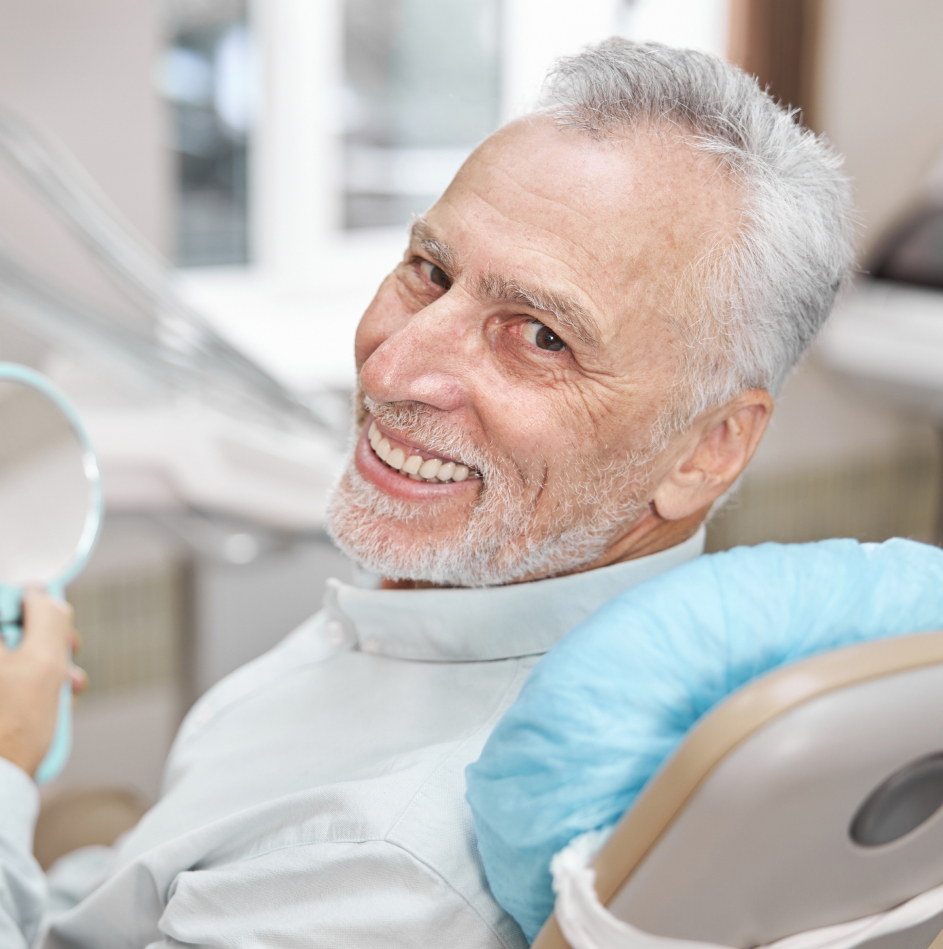
 Premium Porcelain & Smile Artistry in Bergen County
Gentle, Advanced Dental Care for the Whole Family | Same-Day Emergencies | Insurance Accepted

Dr. Maryz Estedrak, DDS

4.9 Star Rated

100% Custom Porcelain
Open the drawer in your bathroom. There's probably a half-used box of whitening strips in there. Maybe two. A tube of whitening toothpaste that's done... something. A small plastic tray from a kit you ordered late one night and abandoned by day three. Maybe a tiny bottle of "advanced gel" that promised everything and delivered a sore gumline.
If that scene sounds familiar, you're the patient teeth whitening was made for.
The at-home stuff isn't useless - it just doesn't deliver what most people actually want, which is a noticeably brighter smile they can see in the mirror this week, not next quarter. Professional teeth whitening is a different category entirely. It's stronger, faster, more even, and built for the kind of result that holds up under indoor light, outdoor light, and the front-facing camera.
If you've been searching whitening dentist near me in Clifton, NJ, here's what professional whitening actually looks like, why it works when the drugstore version doesn't, and how we approach it at EverSmile Dental.

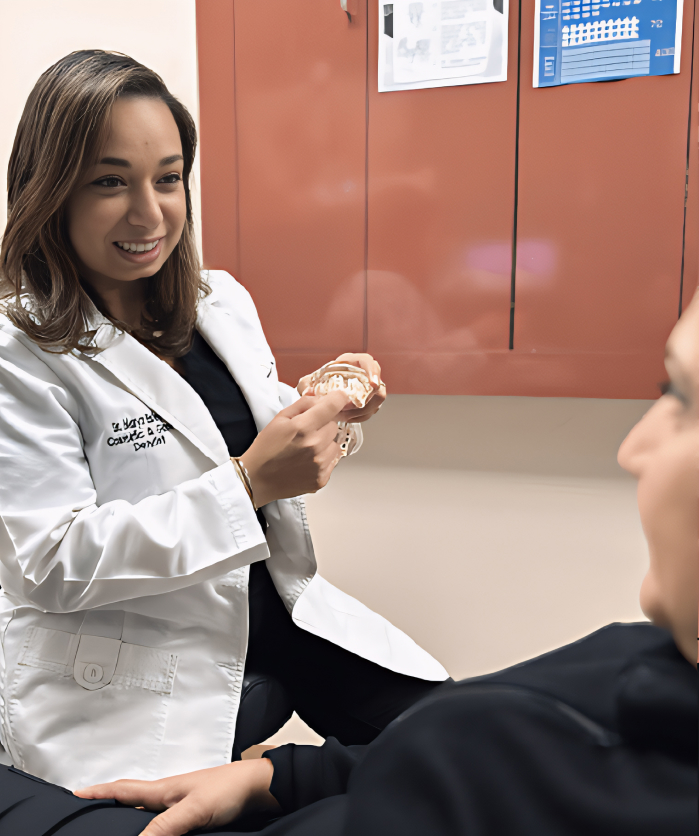
Some of this is genetic. Some of it is your morning routine. Most of it is both.
There are two types of staining your teeth pick up over the years, and they respond to whitening differently:
Surface stains. Coffee, tea, red wine, dark sodas, berries, tomato sauce, soy sauce, curry - anything pigmented that lingers on the enamel. These accumulate gradually, layered on like a slow-developing patina. Smoking accelerates it dramatically. Most patients have some version of surface staining by their thirties, even when they brush carefully.
Deep stains. These sit beneath the enamel and can't be reached by surface-level products. Causes include certain medications taken in childhood (like tetracycline), trauma to a tooth that affected its color from the inside, and the gradual yellowing of dentin that happens as enamel naturally thins with age. Deep stains require more serious treatment.
To remove teeth stains from coffee, wine, and the general dullness that builds up over the years - that's the bread and butter of in-office teeth whitening. The deeper structural discoloration is a different conversation, and one we'll have honestly at your consultation.
Professional whitening uses a higher-concentration peroxide gel than anything available over the counter. Applied in a controlled clinical setting - gums protected, exposure timed, every variable managed - that gel reaches into the enamel and breaks down the pigment molecules that have built up over years.
Here's what that means in practical terms:

The drugstore version uses about 3 to 6 percent hydrogen peroxide. Our in-office whitening treatment is significantly stronger and properly buffered to protect the soft tissue around your teeth.

The treatment is supervised. We're watching gum response, sensitivity, and shade progression in real time. If something needs adjusting, we adjust on the spot.

The result is faster. Most patients see multiple shades of improvement in a single visit, where the strip version takes weeks to deliver less than half that.
That's the short version of why fast teeth whitening only really happens in a dental chair.
Zoom whitening is the specific in-office system we offer at EverSmile Dental, and it's the one we recommend for most patients who want significant improvement in a single visit.
Here's the flow:
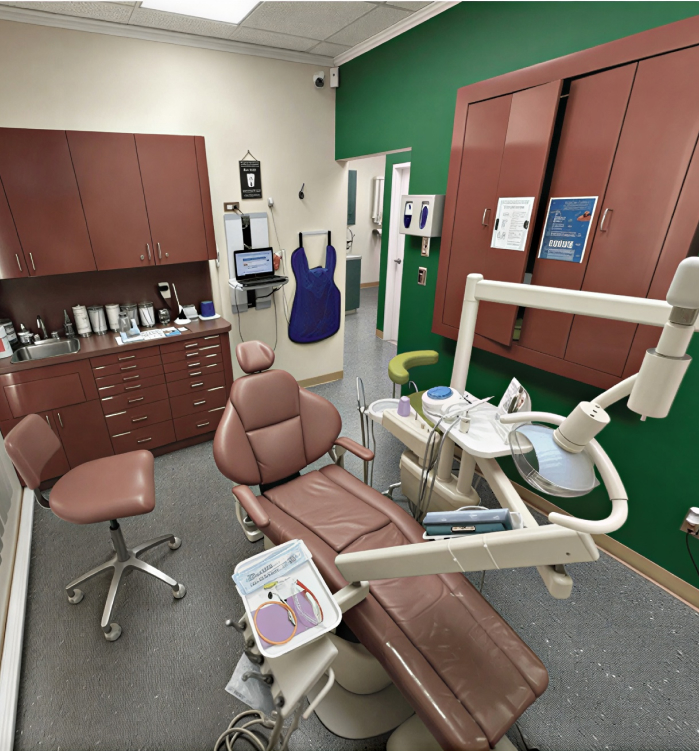
We take a quick look at your teeth, assess your current shade, talk about your goals, and identify any reasons standard whitening might not be the right starting point - recent fillings on visible teeth, sensitivity history, restorations that won't respond to whitening, that sort of thing.
We isolate your teeth and carefully protect the gums and soft tissue with a barrier so the whitening agent only contacts enamel.
Professional whitening gel is applied across the visible teeth, and a specialized whitening light activates the agent. The gel is refreshed in cycles. The full visit takes about an hour, give or take.
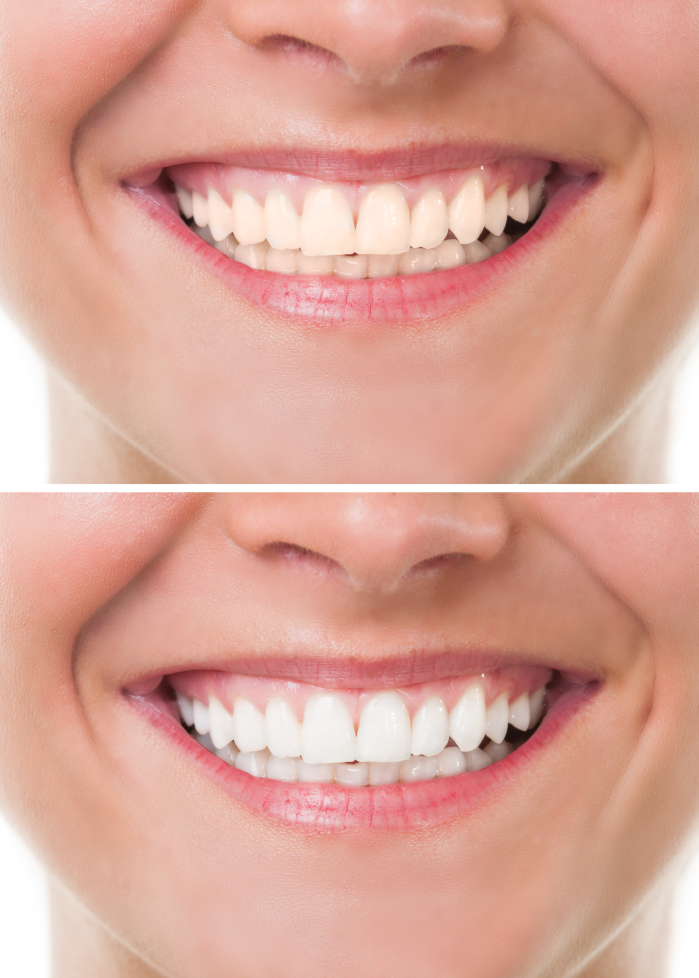
You see the shade change before you leave the chair. Most patients walk out four to eight shades brighter than when they walked in. Some go further. We'll tell you upfront where your enamel is likely to land based on its starting shade.
We send you with guidance on the first 48 hours - when whitening is most effective and your teeth are most receptive to re-staining - and a plan for maintaining the result over time. Patients who want to extend the brightening at home get fitted with custom trays for periodic touch-ups.
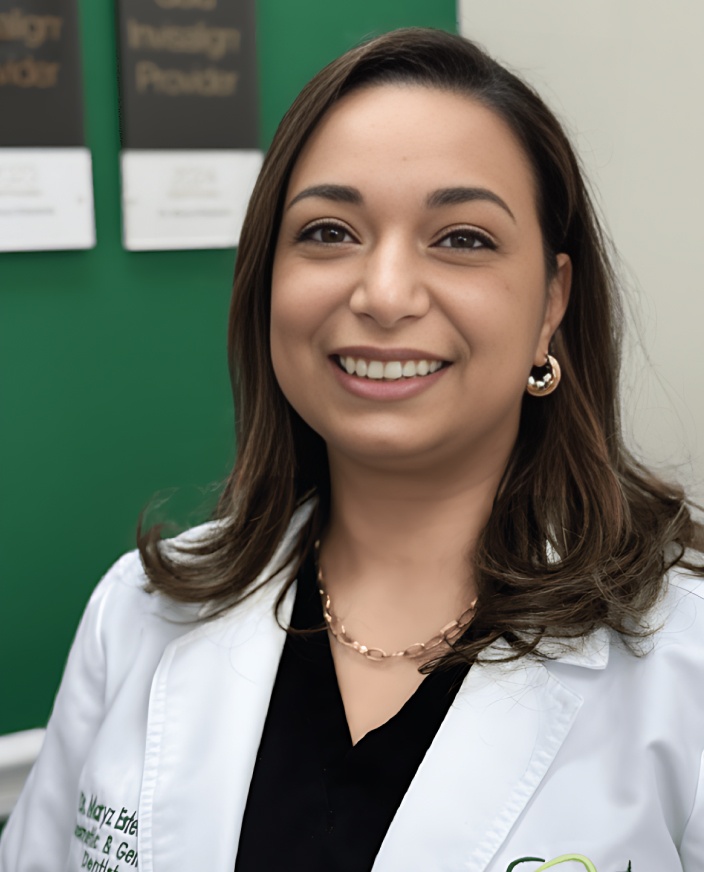
Dr. Maryz Estedrak, family and cosmetic dentist at EverSmile Dental in Saddle Brook, NJ - a certified Invisalign Gold Provider.
479 North Midland Ave, Saddle Brook, NJ 07663
Some practices market a version of this as laser teeth whitening, which is functionally similar to the light-activated Zoom system. The underlying chemistry is the same - the light or laser accelerates the peroxide reaction.
The right candidate for in-office whitening is usually one of these patients:
Whitening for a wedding is one of our most common reasons for a single-visit appointment. Engagements bring people in. So do milestone birthdays, reunions, graduations, headshot sessions, and any photo-heavy event on the calendar. Bright teeth photograph better. They just do.
If you've earned your stains through daily habit and the drugstore products aren't keeping up, professional cosmetic teeth whitening cuts through the buildup the strips never will.
If you've had - or are considering - veneers, crowns, or any visible restoration, we'll often whiten the natural teeth first so the new dental work can be color-matched to your brightest baseline. This is what a real white smile makeover looks like: cosmetic whitening as the first step, then any restorative work designed around the new shade.
Some patients come in without a specific reason beyond the realization that their smile has dimmed over the years and they'd like to do something about it. That's a perfectly good reason.
The drugstore-versus-dentist question comes up at almost every whitening consultation. Here's how to think about it honestly:
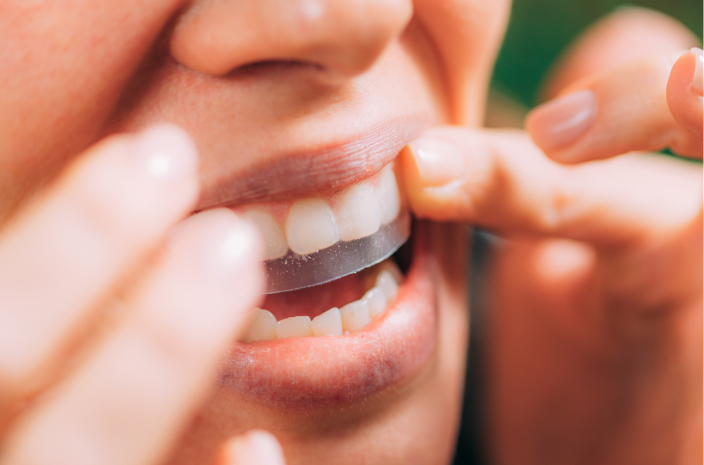
They work, slowly, for mild surface staining. They're inexpensive. They're also inconsistent - the strips don't conform to every tooth surface, the concentration is low, and the soft tissue isn't protected. If you have sensitive gums or any uneven gumline, you'll feel it.
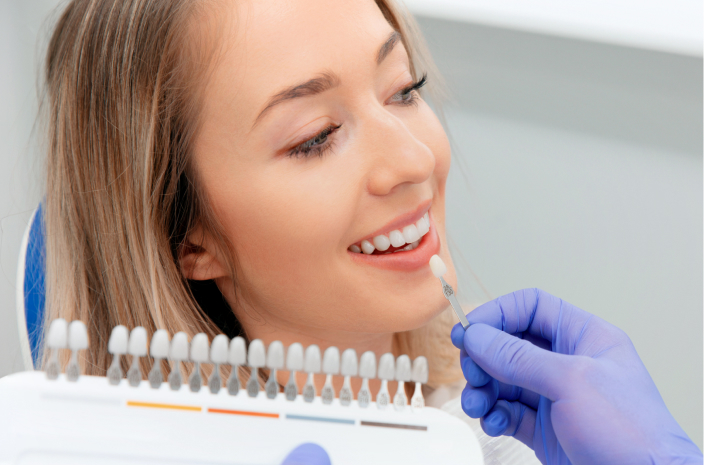
A step up. The trays are molded precisely to your teeth, the gel is stronger, and the application is more even. Results show up over a few weeks of consistent wear. Many patients combine this approach with an in-office session for maintenance.
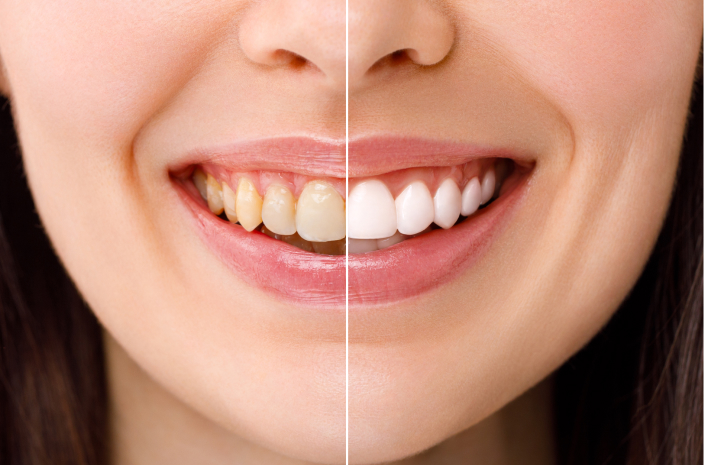
Fast, dramatic, supervised. One visit. Several shades of change. This is what most patients want when they say they want whitening - they just don't always know it has a name.
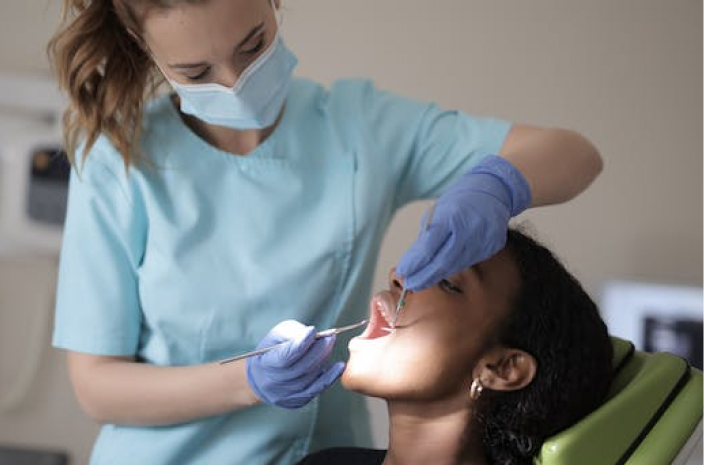
This is what we most often recommend, and it's the closest thing to a real bright smile treatment plan. One in-office whitening session to get to your target shade, plus custom trays for at-home touch-ups every few months. The combination delivers the dramatic result up front and a manageable plan to keep it.
There are a lot of places offering whitening - salons, mall kiosks, "whitening bars," even spas. Most of them aren't dental practices, which means most of them can't legally use the concentrations or supervise the application the way a real dental office can.
A few reasons patients trust us specifically for this work:
Dr. Maryz Estedrak and our team supervise every smile brightening treatment from start to finish. If a tooth has a hidden cavity, a leaky filling, or a structural issue that would be aggravated by peroxide, we catch it before the gel goes on. That's the difference between a dental practice and a kiosk.
We offer Zoom in-office, custom take-home trays, and combination plans. Different patients need different paths, and we tailor the approach to your starting shade, your sensitivity history, and your timeline.
Same-day appointments are often available for whitening, especially when there's an event on your calendar. If you've been wanting to do this for months, the friction shouldn't be scheduling.
If we don't think whitening will deliver what you're hoping for - because of deep staining, existing crowns or veneers, or expectations that don't match your starting shade - we'll say so at the consultation. The best teeth whitening result starts with an honest assessment of your starting point.
Sensitivity is the main reason patients avoid whitening. We use desensitizing protocols throughout the treatment and follow up with at-home guidance to keep things manageable. Most patients are surprised by how comfortable the visit is.
Whitening isn't a one-and-done procedure for most people - it's a maintenance habit, like a haircut. The patients who come in every six to twelve months for a refresh are the ones whose smiles look consistently bright in every photo, every season.

We've seen every kind of whitening result, and we want to be straight with you about a few things going in.
Whitening works exceptionally well on natural enamel. It does not change the color of existing crowns, veneers, fillings, or bonding. If you have visible restorations, we'll talk about how they'll match your newly brightened teeth afterward - sometimes that means whitening first and replacing visible restorations second, sometimes it means a different approach entirely.
Your starting shade determines how dramatic the change will be. Patients with deeply yellowed enamel often see the most striking transformation. Patients whose teeth are already fairly bright will see a more subtle but still visible shift.
And whitening is not permanent. The result lasts months to years depending on diet, habits, and maintenance - but the foods that stained your teeth in the first place will continue to stain them again. The plan we build together accounts for that.
The result typically lasts six to twelve months before noticeable fading begins, though it varies significantly based on diet and lifestyle. Patients who drink coffee, red wine, or dark teas daily will see the result fade faster than those who don't. Custom take-home touch-up trays can extend the result indefinitely with periodic use.
Some patients experience mild, temporary sensitivity in the 24 to 48 hours after a whitening session. We use desensitizing protocols during treatment and provide guidance on managing it afterward. For patients with a history of significant sensitivity, we can adjust the approach - sometimes by spreading whitening across multiple shorter sessions or using a different system entirely.
You can whiten the natural teeth around them, but the restorations themselves won't change color. If you have visible restorations and you're considering whitening, the right approach depends on your goals. We'll walk through it at your consultation.
The sweet spot is about two to three weeks out. Long enough that any temporary sensitivity is fully gone, short enough that the result is at its peak for the day-of photos. Whitening for wedding timelines is something we plan around regularly - bring your date and we'll work backward.
For most patients, one in-office session delivers the full result they came in for. Some patients with deeper baseline staining benefit from a second session a few weeks later, or from combining in-office whitening with custom take-home trays. We'll know after the first visit whether a second is recommended.
NUTLEY, NJ — Upgrades at a power plant on the ON3 campus in North Jersey will continue thanks to “substantial financial backing” from PSE&G, developers say.Earlier this week, Prism Capital Partners announced new financing for a 10-megawatt co-hybrid power plant at the former Hoffmann-La Roche site on Route 3 in Nutley and Clifton.The ON3 complex – which was once former home of Hoffmann-La Roche – has gained a new life since the pharmaceutical company left its former headquarters.Over the...
NUTLEY, NJ — Upgrades at a power plant on the ON3 campus in North Jersey will continue thanks to “substantial financial backing” from PSE&G, developers say.
Earlier this week, Prism Capital Partners announced new financing for a 10-megawatt co-hybrid power plant at the former Hoffmann-La Roche site on Route 3 in Nutley and Clifton.
The ON3 complex – which was once former home of Hoffmann-La Roche – has gained a new life since the pharmaceutical company left its former headquarters.
Over the past several years, Prism Capital has been redeveloping the sprawling complex, which now hosts tenants that include Ralph Lauren and the Hackensack Meridian School of Medicine. It also recently became home to a new Starbucks location.
The campus continues to take shape, with recent commitments from Chase and Chipotle. The campus also houses Eisai Inc., Quest Diagnostics, Modern Meadow, and Proponent Federal Credit Union.
The campus is also home to a 10-megawatt, co-hybrid power plant. According to developers, ON3 is the first mixed-use redevelopment in New Jersey to integrate a central utility plant into its operation.
The result? Significantly less energy draw from the grid – and power redundancy for tenants, Prism says.
The need for power is part of Prism’s plans for ON3, which currently includes 1.55 million square feet of fully occupied space and an anticipated additional build-out of up to two million square feet.
On Tuesday, the firm announced that it has received “substantial financial backing” from PSE&G for the power plant through a grant and interest-free loan. Prism has also secured additional financing through Peapack Private Bank & Trust, which will support the replacement of aging wood-structured cooling towers with modern fiberglass models.
The new, high-efficiency towers also bring the advantage of free cooling during the colder months, Prism said.
Previous upgrades at the plant have included the installation of automated switching to maintain power on campus during a service interruption, as well as the installation of a “more robust” supply and power distribution network throughout the site, the firm said.
“Prism continues to explore options for incorporating new technologies, from batteries to steam-driven equipment,” spokespeople said.
According to Eugene Diaz, principal partner at Prism, the power plant was initially constructed by Hoffmann-La Roche in 1943. It saw several additions in the 1950s, 1960s and 1970s, and was renovated in 1985 with the installation of cogeneration equipment to provide supplemental energy on campus.
“Establishing an energy infrastructure that will support New Jersey’s economic growth is top of mind in our state, and rightly so,” Diaz said.
The company released an update about its Phase IV plans for the campus in 2024, which can be seen here.
Send local news tips and correction requests to eric.kiefer@patch.com. Learn more about advertising on Patch here. Find out how to post announcements or events to your local Patch site.
Clifton, NJ (February 10, 2026) – Emergency responders from Clifton Fire and EMS were dispatched Sunday morning to a reported two-vehicle crash with injuries at the intersection of Broad St and Allwood Rd. Initial dispatch information indicated a collision involving a motorcycle, prompting a focused medical response. Paramedics assessed multiple individuals at the scene while fire crews worked to secure the intersection and manage traffic conditions. Vehicles were located both within the intersection area and nearby, r...
Clifton, NJ (February 10, 2026) – Emergency responders from Clifton Fire and EMS were dispatched Sunday morning to a reported two-vehicle crash with injuries at the intersection of Broad St and Allwood Rd. Initial dispatch information indicated a collision involving a motorcycle, prompting a focused medical response. Paramedics assessed multiple individuals at the scene while fire crews worked to secure the intersection and manage traffic conditions. Vehicles were located both within the intersection area and nearby, requiring coordinated scene management as responders ensured injured parties received care.
Intersections like Broad St and Allwood Rd see a mix of local traffic, turning vehicles, and drivers accessing nearby shopping areas throughout the day. When a motorcycle is involved in a collision in Clifton, responders typically prioritize medical evaluations due to the increased risk of injury for riders. Crews often establish a protected work area within the intersection to allow paramedics to assess injuries while traffic is slowed or redirected. Vehicles may be repositioned to clear active lanes, and drivers in the area can expect brief delays as the scene is documented and hazards are addressed.
Q: What should people document right after an accident?
A: Key details such as location, time, vehicle positions, and visible road conditions can be helpful to record early.
Q: Why do rear-end or intersection accidents happen so often?
A: Sudden stops, turning movements, and limited reaction time can lead to collisions in busy traffic areas.
Q: What happens during the documentation phase of an accident response?
A: Responders record vehicle positions, roadway conditions, and statements to create an official account of the incident.
Clifton Public Schools is responding after online rumors linked school photography company Lifetouch to Jeffrey Epstein — though the connection involves the former CEO of Apollo Global Management, an investment firm tied to Lifetouch’s ownership, not Lifetouch itself.District officials said they met with Lifetouch’s executive team to address questions circulating in recent reporting, according to a letter sent to the Clifton school community.“We know many families have been following the recent reporting...
Clifton Public Schools is responding after online rumors linked school photography company Lifetouch to Jeffrey Epstein — though the connection involves the former CEO of Apollo Global Management, an investment firm tied to Lifetouch’s ownership, not Lifetouch itself.
District officials said they met with Lifetouch’s executive team to address questions circulating in recent reporting, according to a letter sent to the Clifton school community.
“We know many families have been following the recent reporting, and we understand why questions and concerns have been raised,” the district said.
The concerns relate to Lifetouch’s ownership structure. Lifetouch is owned by Shutterfly, which is owned by funds managed by subsidiaries of Apollo Global Management. Apollo’s former CEO and chairman, Leon Black, resigned in 2021 after it was revealed he allegedly paid Jeffrey Epstein for financial services. Lifetouch is not named in the Epstein files, and there have been no allegations involving Clifton Public Schools or its students.
The district said Lifetouch provided a formal letter outlining its position.
“At this time, those matters remain allegations,” the district wrote. “At this time, no evidence has been presented indicating misconduct involving Lifetouch’s operations within our schools or any compromise of student information. Nevertheless, we believe it is appropriate to review the matter carefully and transparently.”
Officials said they presented Lifetouch executives with specific questions reflecting concerns from parents and staff and are awaiting additional responses and documentation.
In a public statement, Lifetouch Group CEO Ken Murphy addressed the rumors directly.
“At Lifetouch, student safety goes beyond the camera lens,” Murphy said. “As a trusted partner to schools for 90 years, we’re committed to protecting the privacy and personal information of every student we serve.”
Murphy said student images are protected and not shared with outside entities.
“When Lifetouch photographers take your student’s picture, that image is safeguarded for families and schools, only, with no exceptions,” he said. “Lifetouch does not – and has never provided – images to any third party.”
Murphy also said the company does not use student images for artificial intelligence or facial recognition.
Addressing the rumors directly, Murphy said: “Lifetouch is not named in the Epstein files. The documents contain no allegations that Lifetouch itself was involved in, or that student photos were used in, any illicit activities.”
He added: “Neither Apollo nor its funds are involved in the day-to-day operations of Lifetouch and therefore no one employed by Apollo has ever had access to any student images.”
An online petition is calling for a full and transparent investigation into Lifetouch’s handling of student photos and personal data.
Clifton school officials said they will provide additional updates once they receive and review more information.

If you've been thinking about whitening for a while - or scrolling through whitening strips on Amazon at midnight wondering if any of them actually work - the simplest next step is a real whitening consultation in our office.
We'll look at your teeth, assess your current shade, talk about your goals, and build the plan that gets you to a brighter smile fastest. Most patients can be scheduled for the actual whitening session within a week, often sooner if there's an event on the calendar.
Call us at (201) 773-3992 to book your whitening consultation, or schedule online whenever it's convenient. Our office in Clifton, NJ welcomes new patients from surrounding communities every week - and there's a good chance we can fit you in this week.
A brighter smile is closer than you think. And it's faster than the box of strips in your drawer ever promised.
 Call Us (201) 773-3992